Tame, breed and ride lox without risking the whole herd
Quick answer
Build a roomy taming area near a manageable Plains herd, drop cloudberries and stay nearby but out of sight until two lox are tame. Feed the pair, keep the local herd below its breeding limit and retain replacement stock. After Moder, make a saddle from ten leather scraps, twenty linen thread and fifteen black metal. Practice on a short land route before taking a spare animal farther from the farm.
Scout in daylight and mark a lox herd away from a Fuling village, tar pit or busy biome border. Collect nearby cloudberries and clear the immediate approach using your normal Plains combat kit.
Choose a site on the same landmass as the routes you want to ride. Put the return portal and waiting shelter away from the animal’s reach, with a clear escape path.
Prepare a roomy pit or terrain enclosure with a temporary entrance, plus a way for you to leave without trapping yourself. Keep buildings back from the edge: a lox stomp can damage things beyond a narrow ditch. Ordinary wooden walls, and even stone construction, can fail under an angry lox.
Our default is to tame one at a time. Lead the selected animal toward the opening while keeping stamina for the escape, exit by the prepared route and close the approach only when you can do so safely. If several chase you, withdraw and reset instead of attempting construction inside their attacks.
Hoe5 Wood + 2 StoneWorkbench level 1
Antler pickaxe10 Wood + 1 Hard antlerWorkbench level 1
Hammer3 Wood + 2 StoneInventory
Workbench10 WoodHammer; no station required
Portal20 Fine wood + 10 Greydwarf eye + 2 Surtling coreHammer; within workbench range
Lox eat cloudberries, barley or flax. We recommend cloudberries so taming does not consume the first flax harvest or your barley planting reserve. Drop food on reachable ground, not in a chest; an obstructed path or low ceiling can stop eating.
Drop a small food stack near the animal and retreat out of its sight. Use the ground in the enclosure rather than trying to hand-feed it.
Stay in the active area, roughly within 64 metres, while remaining concealed. Seeing a distant lox is not proof that you are close enough for taming to progress.
Check for yellow hearts from a protected position. Hunger, alertness or leaving the active area pauses progress. Expect about thirty uninterrupted minutes without a taming-speed modifier; real interruptions make the session longer.
Replenish accessible food when needed and back away again. Wait for the tame message/status before approaching freely. Repeat for a second adult, then retain both as breeders.
Older footage · checked Oct 11, 2026 · before Valheim 1.0 (September 2026)
“How to Use Lox the RIGHT way in Valheim! - Ultimate Lox Guide Taming ,Breeding, Battling and More!” by Samo · Feb 8, 2026 · Pre-1.0 (uploaded Feb 8, 2026)
Feed two calm adults within eight metres of each other. The population check needs fewer than four lox and calves within twenty metres; already pregnant animals can still give birth after the limit is reached. Keep the area active and look for breeding hearts.
A calf takes roughly one hundred minutes to become an adult. Do other nearby work rather than expecting an instant replacement. This route avoids tight automatic-breeder designs: a spacious enclosure makes feeding and failures easier to inspect.
Keep the two named breeders together and food accessible to both. Separate intended travel animals from the pair before taking a mount out.
When breeding stops, count calves as well as adults. Once surplus animals mature, move them to a separate enclosure far enough from the breeding pair to clear the local population check.
Maintain a replacement pair before using adults for travel or meat. Use the saddle below for deliberate repositioning; lox do not have the wolf’s follow command.
Feed injured adults and keep threats away while their health recovers. Food supports passive healing; it is not an instant full-health potion.
Use the Plains processing guide to build an Artisan table, Blast furnace and Spinning wheel after Moder. These are the saddle’s real progression dependencies.
Grow enough flax to preserve the next planting before spinning twenty flax into twenty linen thread. Use barley or cloudberries for animal feed while this batch is reserved.
Collect fifteen black metal scrap from Fulings or their village chests, then process it in the Blast furnace with thirty coal. Reserve the fifteen resulting bars for the saddle. Ordinary smelters cannot process that scrap.
Obtain ten leather scraps through the boar supply loop. Carry the leather, thread and black metal bars to a sheltered Workbench level 1 and craft one Lox saddle.
Put the saddle on the hotbar, approach a tamed adult and activate that slot while aiming at it. Use the attached saddle to mount. Read the on-screen action hint for removal if moving the saddle to another animal.
Artisan table2 Dragon tear + 10 WoodHammer; no station required
Blast furnace20 Stone + 5 Surtling core + 10 Iron + 20 Fine woodHammer; within artisan-table range
Spinning wheel20 Fine wood + 10 Iron nails + 5 Leather scrapsHammer; within artisan-table range
Linen thread1 FlaxSpinning wheel
Black metal1 Black metal scrap + 2 CoalBlast furnace
Find the Lox Saddle (“Use on a lox to be able to ride it”) at a level-5 Workbench, then use it on the tamed Lox in the pit, which reads Lox (Tame, Happy); “Lox is ready for a ride” confirms it.
Take a short loop around the enclosure with no valuable load. Stop, turn, dismount, remount and return through the gate before a longer trip. Let the mount’s stamina recover instead of chaining sprints until it is empty.
Check the lox’s health as well as your own food and armor. A mount can die, and standing still near enemies can make it attack them. Clear deathsquitos and other threats instead of treating its size as protection. Keep its fights away from your workstations.
Mount actions; use your current input bindings
Action
What to practice
Move forward and steer
Use forward movement and hold the steering control while pointing the camera along the route (right mouse button by default). Use your current riding hints; turn on open ground, not at a cliff edge.
Stop
Use the backward movement input to stop; the lox cannot reverse. Turn it around to leave a tight approach.
Sprint
Use sprint for a short burst and watch the mount’s stamina. Riding skill improves through sprinting.
Dismount and fight
Stop on safe ground and use the dismount action. Fight with your weapon on foot, then remount after clearing the threat.
Older footage · checked Oct 11, 2026 · before Valheim 1.0 (September 2026)
“How to Use Lox the RIGHT way in Valheim! - Ultimate Lox Guide Taming ,Breeding, Battling and More!” by Samo · Feb 8, 2026 · Pre-1.0 (uploaded Feb 8, 2026)
A mounted lox can move while its rider is encumbered, but that is not a separate cargo inventory. Our first-trip recommendation is to stay under your own carrying limit so you can dismount and survive if the route fails. Use carts and boats when a haul needs storage rather than a riding experiment.
Scout the land route first, clear narrow approaches and prepare a fed holding area at the destination. Move one spare adult, stop before exhaustion and return the saddle for the next animal only after the first is secured. Do not remove both breeders from the original farm.
Leave live lox enclosed before a portal trip and plan to reach them physically. The inspected portal reference establishes player and inventory travel, but does not directly resolve live-lox compatibility; that behavior remains unconfirmed here. The saddle itself can teleport, so you can move the tool between separate local herds without shipping the animals.
Our recommended ocean solution is to build another local herd and portal its finished materials. Lox can swim, but swimming stamina is not an unlimited ocean-crossing budget. Do not commit the only breeding pair to a crossing with no reachable landing.
Boat transfers are a community transport technique with meaningful failure risk, not this guide’s default supply route. Boats cannot accept a built animal cage, and a loose animal, hostile encounter, collision or rough water can ruin the trip. If experimenting later, use a surplus adult, an already scouted short crossing, a receiving enclosure and a separate recovery boat; preserve the established farm. There is no guaranteed solo transfer procedure or safe crossing distance established by our evidence.
Keep the breeders and a replacement reserve separate. Use the Butcher knife on only a selected surplus adult; a calf is not the intended production harvest. Return pelts and raw meat to protected storage.
For pies, reserve raw meat. Combine two raw Lox meat, two cloudberries and four barley flour at the Food preparation table, then bake the Unbaked lox pie in a fueled Stone oven. Follow the kitchen and farming chain to replenish it.
For a simpler meal, place raw Lox meat on an Iron cooking station over a fire and retrieve it when cooked. Keep this batch separate: Cooked lox meat cannot replace raw meat in the pie recipe.
For a recovery cape, combine six Lox pelt with two smelted silver at Workbench level 2. A connected Chopping block provides that level. Store the resulting frost-resistant Lox cape with the Mountain recovery kit; it is optional if suitable spare protection already exists.
Butcher knife2 Wood + 4 TinForge level 1
Food preparation table5 Iron + 20 Fine wood + 15 Leather scrapsHammer; within workbench range
If attacked, leave the fight with the injured mount when a clear land route remains. Stop in protected ground, provide feed and check health before attempting the route again.
If you die, use the spare food and equipment from home. Return through the established portal, clear the immediate threat and recover your grave using the equipment-recovery sequence. Do not send both breeders as a rescue party.
If the mount dies, recover an accessible saddle and dropped materials only after the approach is safe. A lost animal is replaced from the surviving herd; a new saddle alone does not restore it.
If the farm is breached, restore containment and count surviving adults before taking more animals out. Re-establish a fed pair, then replace travel stock.
Check hunger, alertness, reachable ground and overhead clearance. Enlarge the enclosure or remove an obstructing low roof rather than adding more food to the same unreachable pile.
I left it visible in the distance and taming stopped.
Lox remain visible beyond the active simulation range. Wait closer, concealed and roughly within 64 metres, without repeatedly approaching its face.
There are hearts but breeding later stops.
Check both adults are fed and calm, close enough, and count calves within the twenty-metre population area. Move surplus adults out of that area after preserving the breeders.
The saddle is missing from the crafting list.
Collect all three finished ingredients. The recipe needs linen thread rather than flax and black metal bars rather than scrap, crafted at a sheltered workbench.
The lox will not follow or reverse.
Use its saddle to move it; it has no wolf-style follow command. Stop with the backward input, then turn on open ground rather than trying to back out.
Valheim Wiki: Lox ↗Plains herds, damaging stomp and long reach, feed choices, partner distance, calf maturation, camera steering and danger from surrounding enemies. No exact drop count or immunity to deathsquitos is asserted.community ·
Valheim Wiki: Taming ↗Food/alert/active-area taming conditions, yellow hearts, approximately thirty uninterrupted minutes, low-roof eating obstruction, fed healing and strict population check. Uses the algorithm’s fewer-than-four rule rather than the Lox page’s loose “no more than four” wording.community ·
Valheim Wiki: Lox saddle ↗Ten leather scraps, twenty linen thread and fifteen black metal at a workbench; hotbar attachment, use to mount, and removal. Basic station level corroborated by the GameStar saddle guide linked in the parent journey.community ·
Valheim Wiki: Lox cape ↗Base cape: six Lox pelt and two silver at Workbench level 2; frost resistance. Unresolved Wet interactions and obsolete Forsaken-power notes are not adopted.community ·
Valheim Wiki: Food ↗One raw Lox meat becomes Cooked lox meat at an Iron cooking station; pies use raw meat, cloudberries and barley flour with preparation-table and oven steps.community ·
Valheim Wiki: Riding %28skill%29 ↗Sprinting trains Riding; skill improves sprint speed and stamina use. No exact maximum bonus is required by this guide.community ·
Gamecore Valheim reference: Riding ↗Mount steering follows the camera; walking and sprinting, no reverse, rider weight does not prevent mount movement.community ·
PCGamesN: lox riding controls ↗Forward input starts, back input stops, and held right-mouse steering turns toward the camera under default mouse controls. Sprint makes it charge; player weapon attacks require dismounting.community ·
Valheim Wiki: Boats ↗Boats cannot have a constructed livestock enclosure, attacks/waves/collision can damage them, and wreck recovery is not guaranteed.community ·
Valheim Wiki: Portal ↗Portals move players and permitted inventory. This reference does not directly establish live-lox compatibility, so the guide recommends leaving animals enclosed and marks that behavior unconfirmed instead of inferring it from mod features.community ·
Say where you’re stuck in Valheim. You get one hint at a time from a published kingy.wiki guide, and the answer and its clip stay covered until you ask.
If nothing matches, we keep your words (without emails, links or long numbers) to decide which answers to write next. Privacy

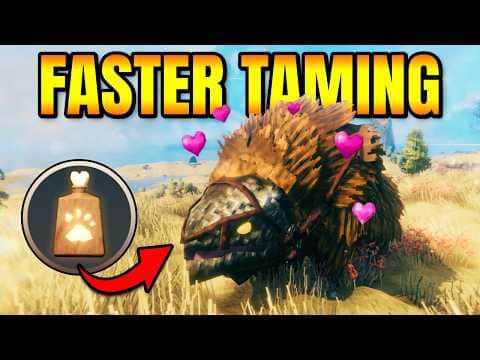 1:08–1:40 · 32 s1.0: luring a Lox into a dug pit, then “Lox (Tame, Happy)”
 3:32–3:39 · 7 sA Lox calming down in the Plains: Tameness 37%, Acclimatizing